Living in Pattaya All Year: How Each Area Holds Up
In short
Choose an area for year-round living by how it behaves in its hardest month, not its best week. Jomtien is easiest without a car if you pick a quieter street, Pratumnak trades shops for quiet, Wongamat and Naklua are the calm north, and Nong Prue and the east offer a house and garden in exchange for driving everywhere.
A holiday, a winter stay and a whole year ask different things of the same city. On holiday you want the beach and the restaurants; for a winter, a few months without a car or boredom. When Pattaya becomes home, you meet the whole year: the crowded high season, the downpours of the rainy season, the building site on the empty plot next door, and neighbours who change every week or never.
We have already compared the areas by daily routine in living in Pattaya as an expat, and by how you will use a condo in the best areas to buy a condo in Pattaya. This article takes a different angle: how each area holds up across twelve months, and over the years you plan to live there. It contains no prices or travel times: they change by building and by hour, and a manager checks what can be verified.
What changes in an area over a year
A week’s visit is a snapshot; living there is a film, and some scenes only appear in certain months. Ask about these:
- The high season. In the northern winter the city fills up, and a street that seemed sleepy in summer can become a different place, with more traffic, fuller restaurants and busier beaches.
- The rainy season. Heavy downpours, more humidity and quieter streets. The question is where the water goes after a storm, and whether it stands at the building entrance or in the car park.
- New construction. An empty plot near the sea rarely stays empty. Building work brings noise for a long time and can change the view for good.
- Your neighbours. A building where most units are let to short-stay guests feels very different from one where the owners live, especially in the low season.
- Getting around. A route that is easy on a Sunday morning can be slow at rush hour in the high season.
Hence two simple rules. Choose an area by its ordinary weekdays, not its weekends. And remember that the street and the building matter as much as the name of the district.
Jomtien and Pratumnak: the southern seafront
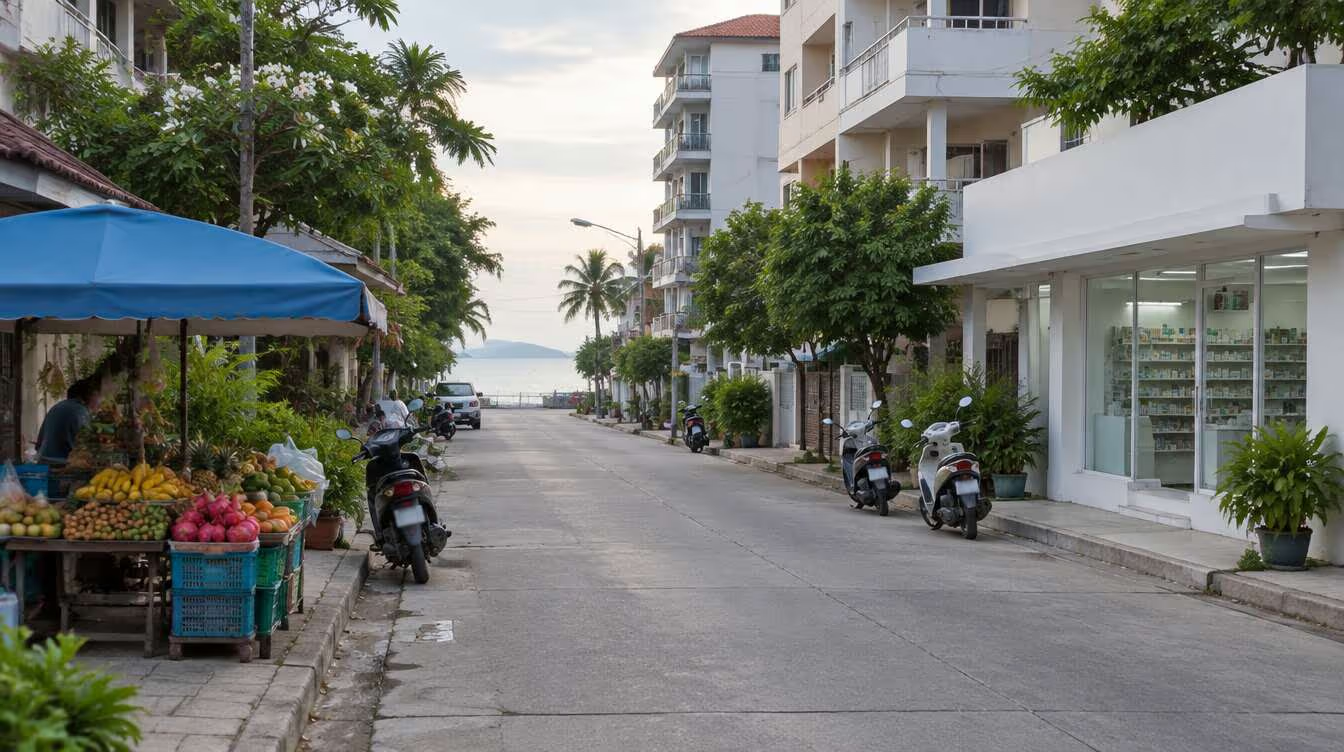
Jomtien is the most residential of the seaside areas. Markets, supermarkets, pharmacies and private clinics are within the area itself, and living without a car is realistic: songthaews run along the beach road and a lot is within walking distance, which makes a first year in a new country noticeably easier.
Over a full year, Jomtien’s weak points are density and the season. The beach road is noisy, the seafront is crowded with visitors in winter, and the empty plot beside a new building may one day hold another tower. For permanent living, a street further back is often more comfortable: quieter, with lower buildings, and the sea and the shops still not far away. Na Jomtien, further south, is a separate area that listings do not always distinguish, so ask to see a building’s exact location on a map.
Pratumnak is the green hill between Jomtien and the centre: quiet inner roads, small coves between the rocks and no bar music in the evening. It changes less with the seasons than the beach roads do, which is exactly why people move there. The price of the quiet is the routine: fewer shops, a ride for the big shop or the doctor, and fewer songthaews up the hill. Think about the slopes too: they do not bother you today, but after a few years in the heat they may.
Wongamat and Naklua: the quieter north
Wongamat is the northern beach lined with residential towers, and next to it lies Naklua, an older neighbourhood with a local market, seafood restaurants and a noticeable share of Thai residents. It is the north in a good sense: calmer than the centre, with the malls of North Pattaya and the road towards Bangkok close by, without crossing the traffic of the city centre.
For year-round living, it matters which end of the area your building stands in. Near Naklua market most errands can be done on foot; at the far end of the beach, life without a taxi or a scooter is harder. The north also has many buildings that have stood for years, and that is useful: you can walk in and see how a building has come through many rainy seasons, what state the lifts and the pool are in, and who actually lives there.
Nong Prue and the east: life inland
East of Sukhumvit Road the city changes: residential neighbourhoods, housing estates with gardens, schools, more greenery and more people who have lived in Pattaya for years. The high season is felt less here, as most visitors stay by the sea.
Nong Prue is the official name of a subdistrict, and developers use it for very different projects, from condos not far from Jomtien to villa estates near the motorway. Look at the point on the map, not the label in the advert. Further inland, Huay Yai has gated estates with security at the gate, a garden and a pool of your own, and quiet nights. It is a common choice for families, but you cannot manage there without a car: the sea, the malls and the school are all a drive away.
In a condominium the building shares the upkeep; in a villa almost everything is yours, from the pool to the roof after a storm. Our guide to the ongoing costs of ownership lists the running costs for both, and our guide to choosing between a condo and a villa compares the two.
The building matters as much as the area
Two buildings on the same street can give you two very different years; in the rainy season especially, the building is your neighbourhood. Before you commit, ask:
- How many units are lived in by their owners and how many are let, and whether the building’s rules allow nightly letting.
- Who manages the building, how long they have done so, and how quickly repairs are dealt with.
- Whether the car park or the ground floor has ever flooded.
- What is planned on the neighbouring plots; a manager can ask the developer.
- How it looks after residents who stay all year: parcels, storage, parking.
In Central Pattaya this matters most of all. Everything is on foot, but it is the loudest part of the city, and a flat on a quiet lane and one above a bar are two different lives. Walk the street on a weekend evening before you buy there. Our article on the beachfront or a short walk from the sea looks at a similar trade-off along the whole coast.
How to test an area before you commit
- If you can, visit twice: in the high season, when the city is full, and in the rainy season. In summer everything looks roomier than in winter.
- Live an ordinary day: the school or work run in the morning, the supermarket and pharmacy at midday, a walk and the noise under the window in the evening.
- Drive from the building to a clinic you would trust at rush hour, not on a quiet Sunday morning.
- Ask neighbours and the building office whether water stands after heavy rain.
- Best of all, rent in the area for at least a season before you buy.
Our article on planning a property viewing trip helps you fit these checks into one visit if a whole season is not possible. Two more things have nothing to do with the area. A home does not by itself give you the right to live in Thailand all year; that needs a suitable visa, and our guide to visas for property owners outlines the routes to discuss with an immigration lawyer. And spending most of the year abroad can affect your tax position and your health cover at home, so check both with an adviser in your own country before you move.
Tell a ROMA ThaiProperty manager what your week looks like: who will live in the home, whether you need a school, whether you will drive, and whether quiet or shops on the doorstep matter more. They will suggest a few areas, shortlist buildings from our project catalogue and say plainly what the drawbacks of each are. Prices and availability are confirmed with the developer.
Questions and answers
Which area of Pattaya is best for living all year round?
There is no single answer. Without a car, Jomtien is easiest, with markets, shops, clinics and the beach road close by, ideally on a quieter street back from the sea. Pratumnak suits those who want quiet, Wongamat and Naklua a calm beach in the north, and Nong Prue and the east a house with a garden, where you will need a car.
How much does Pattaya change between the high season and the rainy season?
Noticeably. In the northern winter the city fills up and the seafronts and the centre become busier and louder; in the rainy season the streets are quieter, but downpours can leave water standing on some low-lying roads for a while. See an area in both seasons if you can, especially if the windows face a beach road.
Is the east of Pattaya good for families?
Many families choose it for houses with gardens, gated estates and schools, and drive to the sea at weekends. Others prefer a larger apartment in Jomtien or Pratumnak. Families often choose the school first and the home near it, and it is worth driving the school run at morning rush hour before deciding.
Should I rent before buying in Pattaya?
If you plan to live there all year, it is the most reliable test. A season as a tenant shows you how the street sounds at night, where the water goes after a storm and who your neighbours are, which no brochure or short visit can tell you.
Related property collections
- Jomtien Condos for Sale, Pattaya
- Pratumnak Condos for Sale, Pattaya
- Wongamat Condos for Sale, Pattaya
- New Developments in Nong Prue, Pattaya
Want to talk it through with a manager? Message us on WhatsApp or leave a request.

Who will answer you
Roman Solovyev · Founder, CEO
- Speaks Russian and English
- Mon-Fri 09:00–22:00 Thailand time
We’ll send a shortlist of projects and their payment plans to your WhatsApp.