Moving to Thailand with Family: Where to Live and What to Buy
In short
Families who move to Thailand well start with the school, then choose the area around it, and only then the home. Most need at least two bedrooms, a complex with a pool, a play area and proper security, and a short drive to school and a clinic. Renting for the first season is usually wiser than buying on arrival.
Moving with children turns the usual order of choosing a home upside down. An adult planning a winter by the sea looks for a view and a café downstairs. A family looks for a school, a doctor, a safe courtyard and a road the children will travel every morning. A resort area you loved on holiday may not work on a school day. This article walks through how to choose the city, the area and the home when the whole family is moving to Thailand, and when it makes sense to buy.
You will not find prices, school fees or dates here. They depend on the project, the school and the year. A manager confirms current figures for a specific home.
School and doctor first, then the area
Families whose move worked out give the same advice: start with the school. Both Pattaya and Phuket have international schools, but they follow different curricula, teach in different languages, run classes of different sizes and do not all accept children in the middle of the year. Pick two or three, write to them before you travel, and ask about admission, waiting lists and the documents they need. Only then look for a home where the school run does not swallow the morning.
Healthcare follows the same logic. There are private hospitals and clinics in both places, but on an island the choice is narrower than in a mainland city. Find out where the nearest clinic with a paediatrician is, whether it works with your insurance, and how long the drive takes on a weekday evening rather than a quiet Sunday morning.
Pattaya or Phuket, and which area
Pattaya is a mainland city. Schools, hospitals, malls and children's activities sit close together, and Bangkok, with its embassies and large hospitals, is a drive away. Families with young children often choose a larger apartment in Jomtien or on Pratumnak hill, close to the beach and with no garden to look after. Families with older children and a car more often choose a house in East Pattaya or Huay Yai and drive to the sea at weekends. What an ordinary weekday looks like in each area is covered in living in Pattaya as an expat.
On Phuket, schools and services are spread across the island, and the area decides how much of the day the family spends in the car. Families relocating most often look at Bang Tao: the Laguna resort with its paths along the lagoons, restaurants and clinics nearby, and international schools a short drive away. The price is denser building and heavier traffic in the high season. Kathu and Phuket Town are calmer and depend less on tourists, and Rawai in the south has a settled year-round community that includes families, at the cost of a longer trip to the airport.
How many bedrooms, and why
Thai listings count bedrooms only; the living room is not included. For a family with a child, two bedrooms is usually the minimum for living rather than holidaying. Whether two is enough depends on a few things:
- Bedtimes. A child goes to sleep earlier than the adults and needs a door that closes, while the living room stays a shared room.
- Working from home. If a parent works remotely, the desk needs a place away from the children's room, and some families take a third bedroom for that alone.
- Visiting grandparents. With two children and guests, two bedrooms quickly run out, and families start looking at three bedrooms or a house.
- Bathrooms. On a school morning a second bathroom saves more nerves than extra space in the living room.
There is a flip side. A larger unit means a larger common fee, because it is charged by area, and one more room means one more air conditioner. Pattaya projects with suitable layouts are collected in two-bedroom condos in Pattaya. If you need three bedrooms and a garden, the choice is wider among villas and townhouses, but they are owned and maintained differently; the guide to condo, villa or townhouse explains how.
The complex and safety: pool, play area, balconies
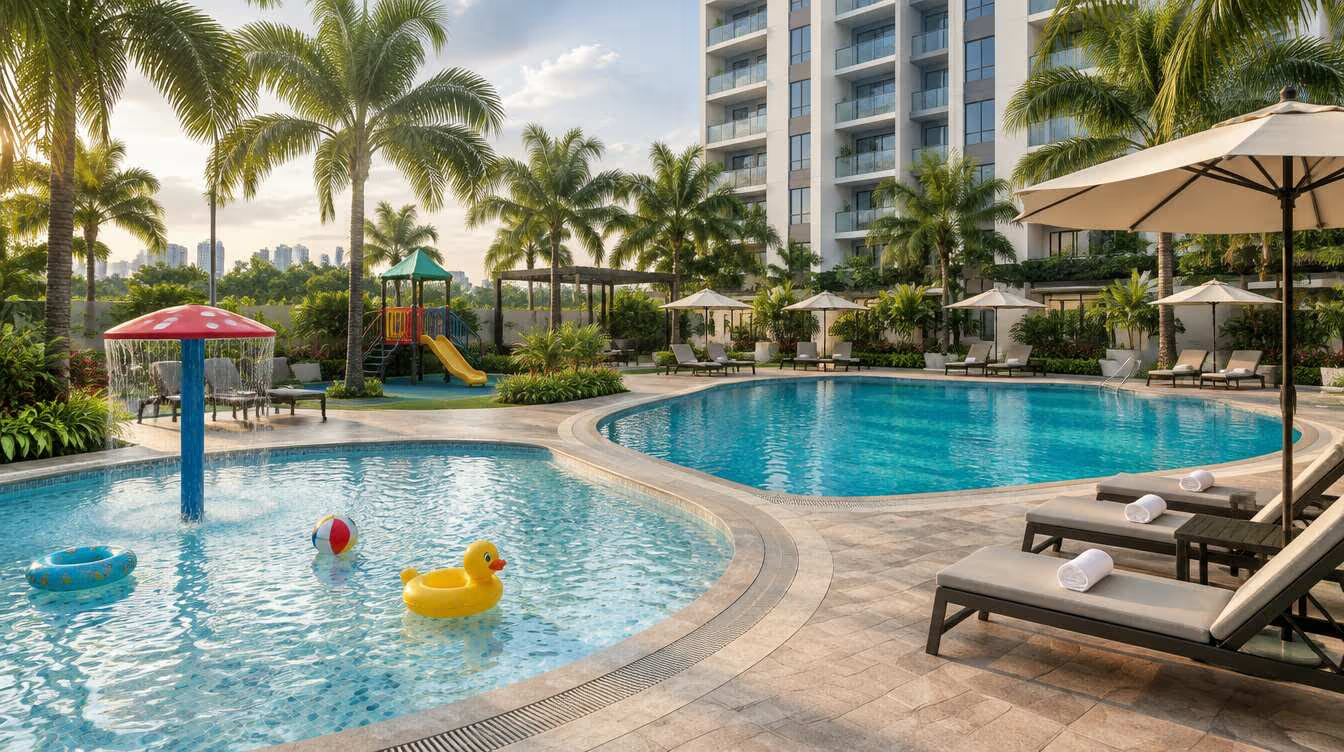
For a family, the home is not just the apartment but everything around it. A good condominium or gated estate gives children what a resort town often lacks: a courtyard without traffic, a pool and other children nearby. Facilities on a project page are as stated by the developer, so check these on the spot:
- The pool: whether there is a shallow children's section, whether it is fenced or gated, and who looks after the water and the rules. Assume there is no lifeguard unless the building says otherwise.
- The play area: in the shade or in full sun, and whether there is an indoor playroom for the afternoon downpours.
- Security: a guard on duty around the clock, key-card access, a closed compound and a separate entrance for cars.
- Balconies and windows: the height of the railing, furniture a child could climb, and whether you are allowed to fit locks or restrictors on windows and balcony doors.
- The way out of the gate: whether there is a pavement to the school bus stop and the shop. Scooters and missing pavements are normal in resort areas.
- The neighbours: if most units are let by the night, a family may feel out of place. Ask the building management who lives there and what the house rules allow.
Then the sea. On open beaches, especially on Phuket's west coast in the rainy season, waves and rip currents are common. A red flag on the beach is not a formality; it is a reason to spend the day by the pool.
Rent first or buy straight away
For a family, the answer is almost always to rent first. A season, or better a school year, shows what no viewing trip can: how the children settle at school, how long the drive takes in a downpour, where you really spend weekends. If the school does not work out, a renter moves house; an owner has to sell.
Buying makes sense once the school is chosen, the area has been tested and the family knows it is staying. Many families pick an off-plan project while they are still renting: the building goes up, they live nearby, watch the construction and meet future neighbours, then move in after handover and inspection. If you need to move in sooner, look at completed buildings. The planned completion date is on the project page when the developer has provided it.
Think about timing as well. The European winter is high season in the resort areas, when good rentals go early. In the rainy season homes are easier to find and an area is easier to judge honestly: you see where water stands after a storm and what stays open when tourists leave. Match your moving date to the school's admission dates, which differ from school to school.
Visas, paperwork and the next step
An apartment or a house does not by itself give your family the right to live in Thailand; that needs a suitable visa for each family member. The routes property owners usually consider are described in the guide to visas for property owners. Conditions change, so check your own situation with an immigration lawyer before the move, and ask the school early which documents it will want at enrolment.
When you are ready, tell a ROMA ThaiProperty manager how many of you there are, how old the children are, which schools you are considering and whether you will have a car. They can suggest two or three areas near those schools, shortlist homes with the right number of bedrooms and tell you plainly about the downsides of each. Prices and availability are confirmed with the developer.
Questions and answers
Is Pattaya or Phuket better for a family with children?
It depends on the school and on how you want to live. Pattaya is a mainland city with schools, hospitals and activities close together and Bangkok within driving distance. Phuket offers more nature and island life, but services are spread out and most journeys are by car. Choose the school first, and the city usually follows.
How many bedrooms does a family need in Thailand?
Thai listings count bedrooms without the living room. For a family with a child, two bedrooms is usually the practical minimum for everyday life. A third bedroom or a house makes sense if a parent works from home, if there are two or more children, or if grandparents visit often. Check the number of bathrooms too.
Should we rent or buy when we move to Thailand with children?
Rent first, for a season or a school year. That shows whether the school suits your children and whether the area works day to day. Buy once the school and the area are settled; many families choose an off-plan project while renting and move in after completion.
Does buying property give my family a visa?
No. Owning a condo or a house in Thailand does not by itself give anyone the right to live there. Each family member needs a suitable visa, and the conditions change. Our guide to visas for property owners gives an overview, and an immigration lawyer can check your specific case.
Related property collections
- Two-Bedroom Condos for Sale in Pattaya
- Two-Bedroom Apartments and Villas for Sale in Phuket
- Jomtien Condos for Sale, Pattaya
- Bang Tao Villas and Condos for Sale, Phuket
Want to talk it through with a manager? Message us on WhatsApp or leave a request.

Who will answer you
Roman Solovyev · Founder, CEO
- Speaks Russian and English
- Mon-Fri 09:00–22:00 Thailand time
We’ll send a shortlist of projects and their payment plans to your WhatsApp.