Buying Property in Thailand Without Flying In: A Practical Checklist
In short
You can buy a condo in Thailand without travelling, as long as someone on the ground works for you at every step: an agent who shows and asks, an independent Thai lawyer who checks, and a person who inspects the unit at handover. Keep the important answers in writing, and settle signatures, power of attorney and the route of your money with your lawyer and bank before you need them.
Many people decide to buy in Thailand at a moment when a flight is not practical: work, children, or a long-haul trip that is hard to justify for a few viewings. The good news is that most of a purchase can be handled from home. The catch is that every step normally done in person now needs a plan and a named person. This is a working checklist of what to arrange, and roughly in what order.
The full process, step by step and with the documents, is in our guide to buying property in Thailand remotely. Here we stay with the practical side: people, habits and the questions to ask. It is general information, not legal advice.
Build the team before you choose the apartment
At home you would walk the site, sit with the lawyer and stand at the bank counter yourself. Buying remotely, you run a small team instead. Put it together before you fall for a unit, not after: an excited buyer picks helpers in a hurry.
- An agent or manager who knows the market, shows projects on live video and carries your questions to the developer. They explain and coordinate; they are not your lawyer.
- An independent Thai lawyer you choose yourself, who works for you rather than for the developer or the agency.
- Someone to accept the unit at handover: a professional inspector, or a person you trust who will follow a checklist.
- Your own bank, told early that international transfers are coming.
- A tax adviser in your country of residence, for what owning property abroad means at home.
The roles should not overlap, and that is the point. If one person offers to do everything, and especially if the lawyer comes as part of the developer's package, stop and ask why. A remote buyer's best protection is that the people who sell, check and inspect are different people.
Video tours: you direct the camera
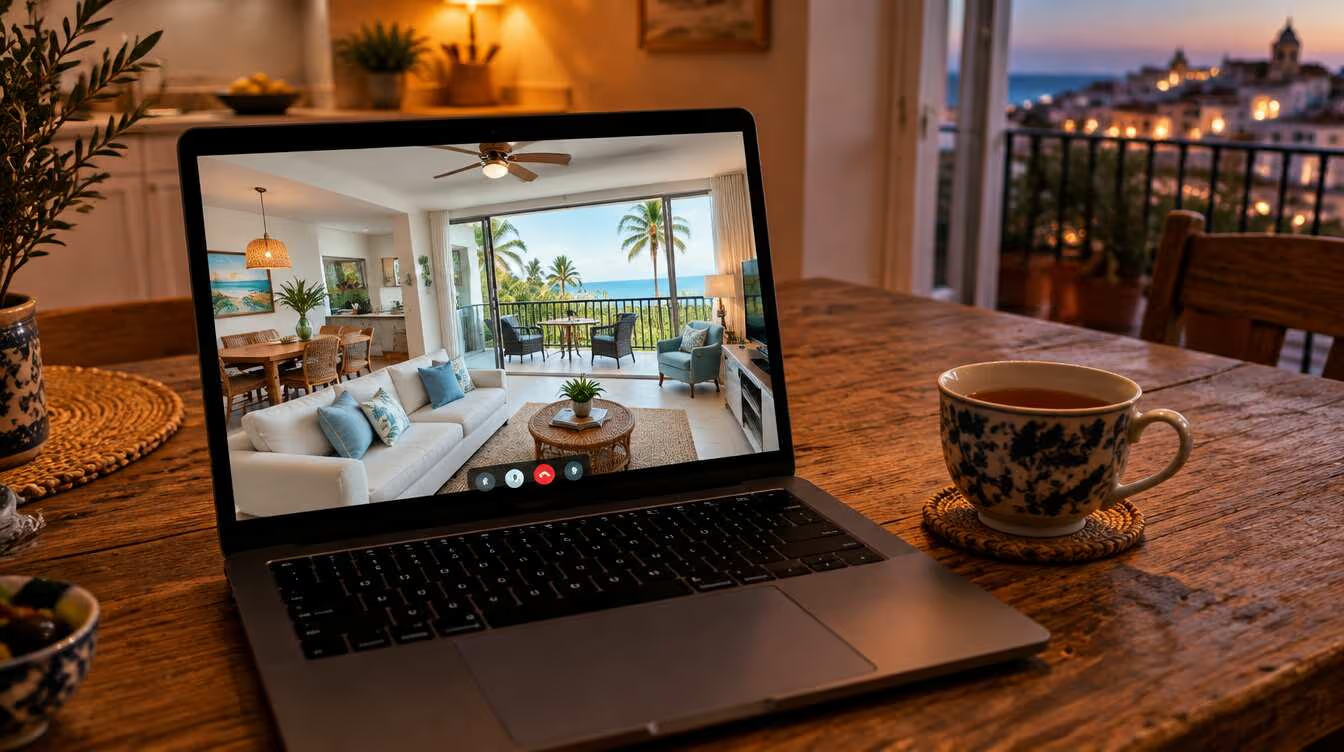
A developer's polished video shows what the developer wants you to see. A live call lets you decide where the camera points. A few habits make the call worth your time:
- Send your questions before the call, so the person on site comes prepared.
- Start on the street, not in the lobby. Ask to see what stands opposite, what is being built nearby, and the walk to the beach or the station without cuts.
- In a finished unit, ask them to run the taps and the air-conditioning, open the balcony door and point the camera at ceiling corners and window frames.
- Ask for a minute of silence so you can hear the street.
- Book a second call at a different time of day. The same street can feel very different in the evening.
- Record the call if the other side agrees, and watch it again with a clear head.
Know the limits as well. A camera flattens distance, hides smells and humidity, and makes small rooms look bigger. For a project still under construction, ask to see the site itself and a completed building by the same developer; our article on checking an off-plan developer before you pay lists what to look for. Remote buying is usually simpler in a finished building, where the unit on your screen is the unit you get.
Put everything that matters in writing
When you are far away and in another time zone, your correspondence is both your memory and your record. Voice notes are convenient but hard to find months later. Anything about money, dates, what is included in the price, or a promise from the developer should reach you by email or as a document. A simple routine helps:
- Keep one folder for the purchase: contract drafts, emails, payment confirmations, photos and call notes.
- After every call, send a short summary of what was agreed and ask for a reply confirming it.
- Before you sign anything, ask your lawyer for a written summary of the document in a language you read comfortably.
- Mark time differences and public holidays on both sides. A question sent at the end of your week may wait until their next working day.
An agent's explanation in your own language is useful, but it does not replace a legal opinion.
Signatures and power of attorney: ask your lawyer first
How you sign the contract, and whether someone will sign for you later, is where remote purchases most often stall. There are several possible routes, from couriered originals to an attorney signing on your behalf, and what is acceptable depends on the developer, the Land Office and the country where you sign. Do not guess, and do not copy a template from a forum. Check with your lawyer:
- how this developer accepts signatures, and whether that is enough for your contract;
- which steps will need a power of attorney, and in what form;
- what certification a document signed in your country will need, before you book a notary;
- whether a limited power of attorney for specific acts is enough, rather than a general one.
Get the list of requirements in writing before you start. A form completed the wrong way usually means doing it all again, and that costs time you may not have before a payment or handover date.
Money: check the route before the first payment
How the money travels can matter for registering the unit in your name, not only for the exchange rate. So check the route in advance with your lawyer and your bank, before you send even the reservation deposit. What to ask and which documents to keep is set out in our guide to sending money to Thailand. Three habits matter even more when you are not there:
- Pay only from your own account to the account named in the contract, never to a personal account.
- If bank details "change" by email or message, do not pay. Call the developer on a number you already have.
- Warn your bank before large transfers, and send each payment with time to spare: banks in different countries work on different days.
Handover when you are not there
Handover is the one stage that needs someone physically in the unit, and it is your last strong moment before the final payment. Decide early who that person will be, because it shapes the power of attorney you prepare. A professional inspector with no link to the developer finds what a friendly eye misses; a trusted friend can do the job if they follow a checklist and photograph everything.
Ask for the inspection to run on a live video call, so you see for yourself what the report describes. Every defect should go to the developer in writing, with a photo and its location, and come back with a written commitment to fix it. Do not sign an acceptance without remarks, or send the final payment, until you have that list and the developer's response; when and how to sign is a decision for you and your lawyer. What to check, room by room, is in our guide to condo handover.
At ROMA ThaiProperty your manager shows projects on live calls, takes your questions to developers and brings back written answers, and helps coordinate handover on the developer's side. We will tell you plainly when a question needs your lawyer, because we do not replace one.
Questions and answers
Can I buy a condo in Thailand without ever visiting?
Most of the purchase can be done from home, provided people on the ground work for you: an agent who shows the property, an independent Thai lawyer who checks it, and someone who inspects the unit at handover. If you can make one trip, the most useful moment is before you sign.
Will I need a power of attorney?
Quite possibly, for steps such as handover or registration, but your lawyer decides which steps, in what form and with what certification. Get those requirements in writing before you visit a notary.
Who should inspect the unit if I cannot fly in?
Ideally an independent inspector with no link to the developer, or someone you trust who follows a checklist. Ask them to do it on a live video call and to send the developer a photographed defect list in writing.
Is a finished condo easier to buy remotely than off-plan?
Usually, because the unit and the view you see on the call are the ones you get. Off-plan you are buying a render and the developer's track record, so look at buildings the developer has already completed first.
Related property collections
- Ready Condos in Pattaya: Completed Buildings
- Ready Condos for Sale in Phuket
- Pattaya Condos for Sale — New Developments
- Phuket Property for Sale: Condos and Villas
Want to talk it through with a manager? Message us on WhatsApp or leave a request.

Who will answer you
Roman Solovyev · Founder, CEO
- Speaks Russian and English
- Mon-Fri 09:00–22:00 Thailand time
We’ll send a shortlist of projects and their payment plans to your WhatsApp.