Buying a Villa in Pattaya: What to Check Before You Commit
In short
Most new villas in Pattaya are inland, in East Pattaya and areas such as Huay Yai, so a villa here means a house with a garden and a pool, and a life with a car. Before you buy, check the estate and who runs it, who will look after the house while you are away, and exactly what will be registered in your name. That last point is for an independent Thai lawyer.
Most buyers in Pattaya start with a condo near the sea. A villa tends to come up later, when the whole family no longer fits into a small flat or the noise of the beach road starts to wear thin. But a villa is a different decision, not just a bigger one: it changes where you live, how you buy and what happens to the house while you are back home.
This article is about Pattaya specifically. If you are weighing up the islands instead, see our articles on condo or villa in Phuket and buying a villa on Koh Samui. We quote no prices, fees or returns: a manager confirms the figures for a particular house with the developer. Current listings are on our page of villas and houses for sale in Pattaya.
Where Pattaya's villas actually are
Pattaya's seafront is densely built up, so a new villa is usually some way from the sea. East of Sukhumvit Road lies East Pattaya: residential streets, schools and gated estates, relatively close to the malls and the city centre. Further out, south-east of the city, is Huay Yai, which has become almost a byword for a pool villa and village quiet.
One name confuses a lot of buyers: Nong Prue. It is not a neighbourhood but an official subdistrict, and the same address can belong to a condo not far from Jomtien or to a villa estate out by the motorway. So when a villa is described as being in Nong Prue or near Jomtien, ask for the exact location and look at it on a map rather than trusting the area name in the advert. Our project pages show the straight-line distance to the sea when we have that figure, and a manager will check the actual route by road.
Gated estate or stand-alone house
Most new villas in Pattaya are sold on estates: a staffed gate, internal roads and sometimes a clubhouse with a shared pool and gym. That suits owners who spend much of the year abroad, because someone looks after the gate and the shared areas while they are away. The estate is funded by a common fee, so find out exactly what it covers and what is billed separately. Project pages show the common fee per square metre per month when the figure is in our database; the amount for a particular house is confirmed by a manager with the developer.
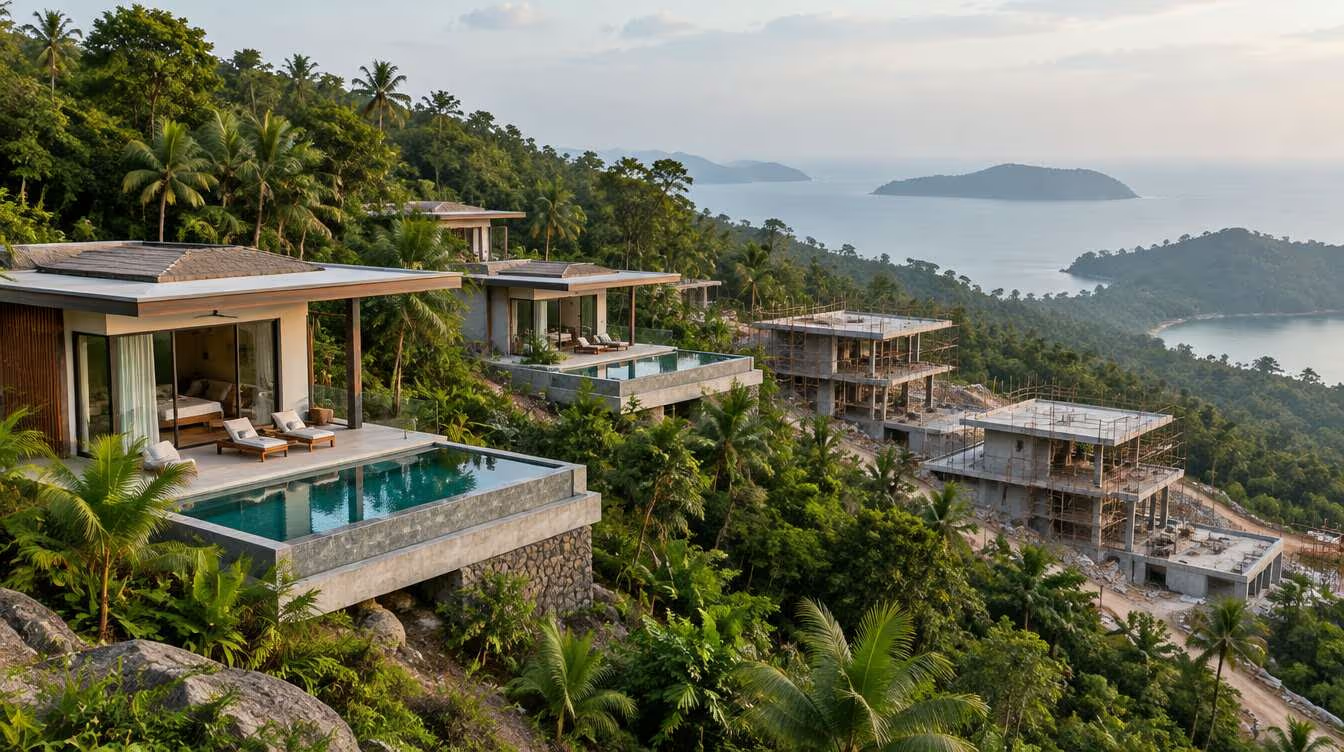
A new estate is usually built in phases, so the first question is what is already finished and what is still only on the plan: the roads, the drainage, the clubhouse, the perimeter wall. Buying early can mean a wider choice of plots, but also living next to a building site for a while. A stand-alone house gives you more freedom, but security, the access road and the upkeep are yours to arrange. Either way, check the developer first. Our guide to checking a Thai developer explains how, and our article on off-plan risks in Thailand covers buying before the house is built.
What you are buying: land, house and contract
This is the biggest difference from an apartment. A unit in a registered condominium can generally be owned in a foreigner's own name, under certain conditions. A villa stands on land, and foreigners generally cannot hold Thai land directly. Developers therefore offer foreign buyers various structures, and your rights are whatever your project's contract says, not the brochure.
So the order of events is fixed. First, an independent Thai lawyer who acts only for you, not for the developer, reads the contract and the land documents and explains what happens on resale and on inheritance. Only then do you pay a deposit. If anyone promises you full ownership of a villa, ask in writing whose name the land will be registered in, and pass the answer to your lawyer. The basics are in our guide to foreign ownership in Thailand, and the wider comparison is in condo, villa or townhouse. The tax side at home is a question for your own accountant before you commit.
The pool, the garden and the months you are away
Pattaya is hot and humid all year, and the rainy season brings heavy downpours. A house left closed for months shows it quickly: algae in the pool, mould in the wardrobes and a garden that has taken over the yard. In a condo the building looks after the pool and the grounds. With a villa they are yours, even when you are on the other side of the world.
The options are an estate maintenance service, if there is one, a management company that looks after the house and any letting, or individual contractors coordinated from abroad. Whichever you choose, put the details in writing: who holds the keys, how often the house is aired, what photos you receive and who may call out a technician. Ask about the pool too: its filtration system, who repairs a broken pump and where the water goes in a storm. The running costs of a house, from the pool to insurance, are listed in our guide to the ongoing costs of owning property.
Renting a villa out: a different tenant
The people who rent a villa are not the people who rent a beach studio. They are usually families and groups who want a whole house with a pool for a holiday, families staying for the winter or a school year, and people working in the area who want a garden. A guest staying a week expects someone to meet them and clean the pool between stays; a tenant for a year expects a proper kitchen and a washing machine.
Letting by the night is regulated in Thailand by its own rules, and many estates have house rules of their own. What is allowed for a particular house is something to check with a lawyer before you buy, not after. How to choose a management company and what its agreement should say is covered in our guide to renting out and managing your property. Any income figure you get from us is an agency estimate with its source and date, and rental income earned abroad is also a question for your tax adviser at home.
The drive to the beach, and to everything else
The price of quiet is distance. From most villa estates you drive to the beach, the mall and the school, and songthaews, Pattaya's shared pick-up taxis, rarely come into these areas. Almost every household on an estate keeps a car or a scooter. If you do not plan to drive in Thailand, an apartment near the beach will probably suit you better; how different parts of the city work for living there all year is covered in Pattaya areas for year-round living.
Distance has an upside too: from the east of the city it is relatively easy to reach the main roads towards Bangkok and the airport without crossing the traffic in the centre. Before you choose an estate, drive from it to the beach and to a school at an ordinary morning rush hour, and back in the evening. That drive will be part of every day you spend there.
A short checklist before the deposit
- The exact location and the real route to the beach, the supermarket and the school, not just the area name.
- What is already built on the estate, what is still planned, and who will manage it after handover.
- What the common fee covers and what is billed separately.
- Where the water goes around the house and on the internal road after heavy rain.
- Who will look after the pool and the garden while you are away, and under what written arrangement.
- What the estate rules allow for letting, as checked by your lawyer.
- What exactly will be registered in your name, according to the contract and the land documents.
Tell a ROMA ThaiProperty manager who will live in the house, how long you will stay each year, whether you plan to let it and whether you will drive. They will suggest villas from our project catalogue, ask the developer for the estate plan and the documents, and tell you plainly what is not yet known. Price and availability are confirmed with the developer before you decide.
Questions and answers
Where are most villas in Pattaya?
Most new villa projects are inland: in East Pattaya, beyond Sukhumvit Road, and in areas such as Huay Yai south-east of the city. The seafront is mostly apartment buildings, so if walking to the beach matters to you, you are probably looking for a condo.
Can a foreigner own a villa in Pattaya in their own name?
Not as simply as a condo unit. Foreigners generally cannot hold Thai land directly, so each project offers its own structure, set out in the contract. Before paying a deposit, have an independent Thai lawyer review the contract and the land documents.
Do I need a car if I live in a Pattaya villa?
Almost always. From most estates you drive to the beach, the shops and the schools, and shared taxis rarely come into these areas. Without your own car or scooter, daily life is hard work.
Can I rent out my Pattaya villa while I am away?
Usually through a management company that handles guests, cleaning, the pool and the garden. Nightly letting is regulated by law and by estate rules, so check with a lawyer what a particular house allows before you buy.
Related property collections
- Pattaya Villas and Houses for Sale
- Huay Yai Villas and Houses for Sale, Pattaya
- New Developments in Nong Prue, Pattaya
- Pattaya Condos for Sale — New Developments
Want to talk it through with a manager? Message us on WhatsApp or leave a request.

Who will answer you
Roman Solovyev · Founder, CEO
- Speaks Russian and English
- Mon-Fri 09:00–22:00 Thailand time
We’ll send a shortlist of projects and their payment plans to your WhatsApp.